Saturday, February 22, 2014
Password hashing updated
I improved the security of the password hashing system. As a side-effect all my old character-accounts are now invalid, so I had to delete them from the database. I could have done it in a backward-compatible way and retain the characters, but why bother when I don't have a production server yet.

Wednesday, February 12, 2014
Some new tiles and height levels
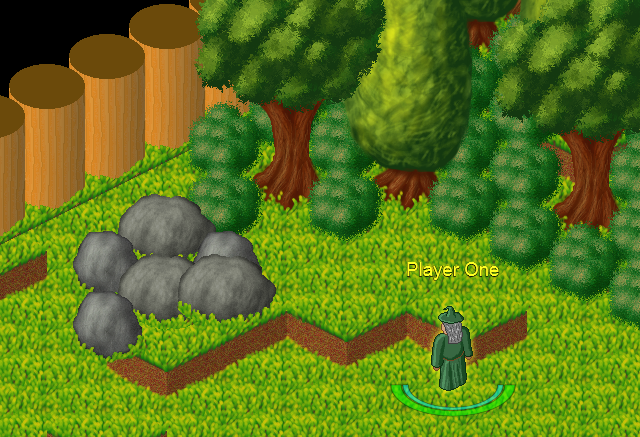
I also experimented with adding height levels. Those you see on this screenshot are entirely client-sided and randomly generated. I am unsure if I will keep it.
First, I am not sure if it is even going to add so much gameplay-wise for the amount of work it would mean (routefinding etc.). Then there is the problem that Tiled can't do isometric maps with height levels. So I would either have to patch Tiled, find another editor or write my own map editor after all.
Thursday, December 26, 2013
Effect areas
I added a new feature: Status Effect areas.
These provide buffs (or debuffs) to anyone standing in them. This feature will make positioning in combat even more important and diversify the game experiences on different maps.

These provide buffs (or debuffs) to anyone standing in them. This feature will make positioning in combat even more important and diversify the game experiences on different maps.

Thursday, November 28, 2013
Got rid of multiple characters per account
I got rid of accounts. Each character now has its own password.
Why did I do this?
1. this simplifies lots of things in the code like banning, permission handling etc.
2. It makes it easier to do registration during the tutorial, because now there is only one name the player needs to make up.
3. I don't expect that many players will create more than one character, because there isn't much reason to do so in my game system.
4. There is no way to stop people from making more than one account anyway, so they are no appropriate method to tell natural persons apart.
The next thing will be to allow players to start the tutorial with an unregistred character. The player will choose a password when the tutorial is over.
Why did I do this?
1. this simplifies lots of things in the code like banning, permission handling etc.
2. It makes it easier to do registration during the tutorial, because now there is only one name the player needs to make up.
3. I don't expect that many players will create more than one character, because there isn't much reason to do so in my game system.
4. There is no way to stop people from making more than one account anyway, so they are no appropriate method to tell natural persons apart.
The next thing will be to allow players to start the tutorial with an unregistred character. The player will choose a password when the tutorial is over.
Friday, November 22, 2013
Experimenting with JSP
Today I experimented a bit with Tomcat, Servlets and Java Server Pages. I made a char-viewer which gets a character from my MongoDB and exports some of its data as a website.
I really like the technology. I wonder if I should use it for some web-based components. But on the other hand, I would prefer to avoid mixing too many technologies. So I would prefer all of my non-game web applications to run in the same server application. I would, for example, like to have a forum and I don't want to program it myself. But while I was able to find plenty of free forum software in PHP, I couldn't find anything properly mature in JSP.
Seems like I need to brush up my PHP skills soon. I don't like it very much, but there is hardly a way around it.
I really like the technology. I wonder if I should use it for some web-based components. But on the other hand, I would prefer to avoid mixing too many technologies. So I would prefer all of my non-game web applications to run in the same server application. I would, for example, like to have a forum and I don't want to program it myself. But while I was able to find plenty of free forum software in PHP, I couldn't find anything properly mature in JSP.
Seems like I need to brush up my PHP skills soon. I don't like it very much, but there is hardly a way around it.
Thursday, November 21, 2013
About the death of Glitch
About a week ago, I read that Glitch closed down due to lack of players. I must admint I never played that game. But the game had some striking similarities to mine. It too was an MMORPG, it was web-based and it was breaking conventions. I wondered if the same would happen to my game. Could it? Let's see what their reasons were for closing down.
But I am not using Flash, I am using HTML5 which all the big tech companies support. I think I am pretty save in this regard.
I am still taking this as a warning: I have to try to keep my infrastructure as low-maintainance as possible.
It seems to me like what they made wasn't so much of a game but rather some interactive community something which threw together gimicky game elements without having anything one could consider the "core gameplay mechanic". Sure, there seemed to be an amazing amount of creativity behind the project. But unfortunately they let that creativity run lose without any sense for coherent structure.
I hope I got this covered. Sure, I can't claim that I am a professional game developer yet, but game development is my hobby for about 20 years. I also collected plenty of experience with The Mana World. I believe that I know what I am doing when it comes to game design.
The big strongpoint of browser-based games is that it is easy to start playing them. No gigabyte-sized download, just visit the website and you are good to go. But that's also their greatest weakness: It's too easy to close the browser window and forget that they exist. By making the game too hard to get into they fell prey to that weakness.
This showed to me that starting my games content development with the tutorial was definitely the right choice.
Technology choice
One reason they mentioned was that the decision to use Flash turned out to be bad. I think they are overrating this factor. Sure, they couldn't port it to the iPad, but when people really wanted to play it, they could have played it on their PC. And seriously, who has an iPad but no PC? Sure, Microsoft and Apple have both decided that Flash needs to die, but so far their attempts at killing it didn't work out so well.But I am not using Flash, I am using HTML5 which all the big tech companies support. I think I am pretty save in this regard.
Too complex infrastructure.
Their closing-faq mentions that "It takes a full-time team of competent engineers & technical operations personnel just to keep the game open. Even if there was a competent team that was willing to work on it full time for free, it would take months to train them. Even then, the cost of hosting the servers would be prohibitively expensive.". When that is true, they really have scaling issues. Less players should mean less work to do. But obviously that wasn't the case. Maybe their infrastructure was designed to scale up, but not down.I am still taking this as a warning: I have to try to keep my infrastructure as low-maintainance as possible.
They didn't know what they were doing.
There is a really interesting article on Gamasutra which mentions that the people who made it didn't really had much of a clue about game development.It seems to me like what they made wasn't so much of a game but rather some interactive community something which threw together gimicky game elements without having anything one could consider the "core gameplay mechanic". Sure, there seemed to be an amazing amount of creativity behind the project. But unfortunately they let that creativity run lose without any sense for coherent structure.
I hope I got this covered. Sure, I can't claim that I am a professional game developer yet, but game development is my hobby for about 20 years. I also collected plenty of experience with The Mana World. I believe that I know what I am doing when it comes to game design.
Not accessible enough
Another aspect the Gamasutra article mentions how hard it was to get into the game: "A lot of people were just like 'I don't know what the fuck I'm supposed to do.' Some people took 'I don't know what I'm supposed to do' as an invitation to explore and ended up loving it. Other people closed the browser. That's it."The big strongpoint of browser-based games is that it is easy to start playing them. No gigabyte-sized download, just visit the website and you are good to go. But that's also their greatest weakness: It's too easy to close the browser window and forget that they exist. By making the game too hard to get into they fell prey to that weakness.
This showed to me that starting my games content development with the tutorial was definitely the right choice.
Friday, November 1, 2013
Status indicators
During playtesting I realized that when I died it was often because I wasn't aware of how low my HP were and that my barrier was already depleted.
The reason is that the players eyes need to focus on what is happening at the center of the screen during combat, but also to the status bars at the upper right edge of the screen. It's really hard to pay attention to both at the same time.
To solve this problem I decided that these markers need to get closer to the player-character. So I added some HUD elements right below it:

The arcs are, from inner to outer, the current percent-status of MP, HP and barriers. When the character would have multiple barriers, they would appear as additional concentric arcs around it. When the player wants to know the exact numbers, they can still look at the upper-right corner. But these arcs gives the player a constant awareness of the status of their player-character.
The reason is that the players eyes need to focus on what is happening at the center of the screen during combat, but also to the status bars at the upper right edge of the screen. It's really hard to pay attention to both at the same time.
To solve this problem I decided that these markers need to get closer to the player-character. So I added some HUD elements right below it:
The arcs are, from inner to outer, the current percent-status of MP, HP and barriers. When the character would have multiple barriers, they would appear as additional concentric arcs around it. When the player wants to know the exact numbers, they can still look at the upper-right corner. But these arcs gives the player a constant awareness of the status of their player-character.
Sunday, October 27, 2013
Barrier Tutorial
I added a barrier tutorial to the tutorial map.
The player has to walk through a course without taking any non-shield damage.
This required two new scripting abilities: Map areas which trigger scripts and attacks which trigger scripts. Both of these new abilities will likely come in handy in the future.
The player has to walk through a course without taking any non-shield damage.
This required two new scripting abilities: Map areas which trigger scripts and attacks which trigger scripts. Both of these new abilities will likely come in handy in the future.
Saturday, October 26, 2013
Balancing through testing
To test my formulas I created a little program to auto-generate mobs with average stats from level 5 to 100. I want to avoid this in the final version (or do I?), but for now it is a nice balancing tool.
This really helped me to file off some edges and balance my procedural barrier generation algorithm. Next one are healing spells.
This really helped me to file off some edges and balance my procedural barrier generation algorithm. Next one are healing spells.
Tuesday, October 22, 2013
Balancing through number-crunching

After the stressful summer with the election and my sailing hours I wanted to continue development right away, but instead of that I decided to use the distance I gained from the project to take a 2nd look on some of my code, so I was doing mostly minor cleanups and refactoring.
Then I decided that it is time to start with the content. But when I wanted to do so I realized that I had no idea what I was doing. What's a good experience yield for a Level 5 monster? How much is a spell supposed to cost? How much defense should a level 10 robe have? Just making up values on the spot would not have been wise, as I would have to balance it through trial and error. So I decided to buy some Magic Chart paper (cool stuff, by the way. It clings to any surface through electrostatics. You can easily move them around without leaving a trace. You can draw on it with dry-erase marker and just wipe it away just like on a whiteboard) and summarized all the level-dependent formulas I have.
While doing this I realized some balancing errors which would have been quite bad in practice (MP increases quadratic but MP regeneration just linear - ooops). These handy charts will make it much easier for me to make up content.
Subscribe to:
Posts (Atom)